
Top Signs You Need Garage Door Service – Don’t Ignore These
A garage door that takes three seconds longer to open than it used to isn’t “just getting old.” That delay is often the first thing a door tells you before something expensive breaks, and most homeowners miss it. We’ve seen doors that growled for a month before a cable snapped, and others that reversed twice at the floor before anyone thought to check the sensors. The signs are there, and they point to a specific part. Here’s how to read them.
If any of this sounds like your door and you’d rather leave the diagnosis to a specialist, call (844) 493-4287. We answer 24/7. Fast dispatch from 7am to 7pm, Sunday through Friday, and estimates are free.
Key Takeaways
- Sounds are diagnostic: grinding, squealing and popping each point to a different component.
- A slow opener is often a spring balance problem, not a motor problem. Replacing the opener first wastes money.
- Frayed cables are a snap risk, and a cable loop visible on the drum means stop using the door now.
- A door that reverses can be a sensor issue in warm weather or a track alignment issue in cold weather. The season helps you tell which.
- Springs and cables are high-tension parts. This is not a job to learn on.
What does each garage door sound actually mean?
Each sound a garage door makes points to a specific component. Grinding usually means rollers or bearings are dry or worn. Squealing tends to come from metal-on-metal friction in the hinges or rollers. A sharp popping is the one we take most seriously: it often signals a torsion spring under stress or a cable that has slipped its drum. Learning to tell these apart saves you guesswork.
Here’s how we read them in Crystal Lake:
- Grinding. Metal rollers with worn bearings, or a bent track the roller is scraping against. Ignore it and the roller seizes, which drags on the opener.
- Squealing or screeching. Hinges and rollers that have lost lubrication, or a torsion tube that’s dry. Usually the cheapest sound to address.
- Popping or snapping. A spring that’s slipping or a cable coming loose from the drum. This one means stop and look before you run the door again.
- Rattling. Loose hardware, a bolt backing out, or a panel that’s working itself free.
Sound is the easiest signal to collect because you hear it every time you leave. In our experience, homeowners in Crystal Lake tend to tune out a squeal for weeks and only call once it becomes a grind. That gap is where small friction problems turn into bent tracks and stressed springs. If a new noise showed up after a string of cold snaps, it’s worth paying attention sooner rather than later.
When should you stop using your garage door immediately?
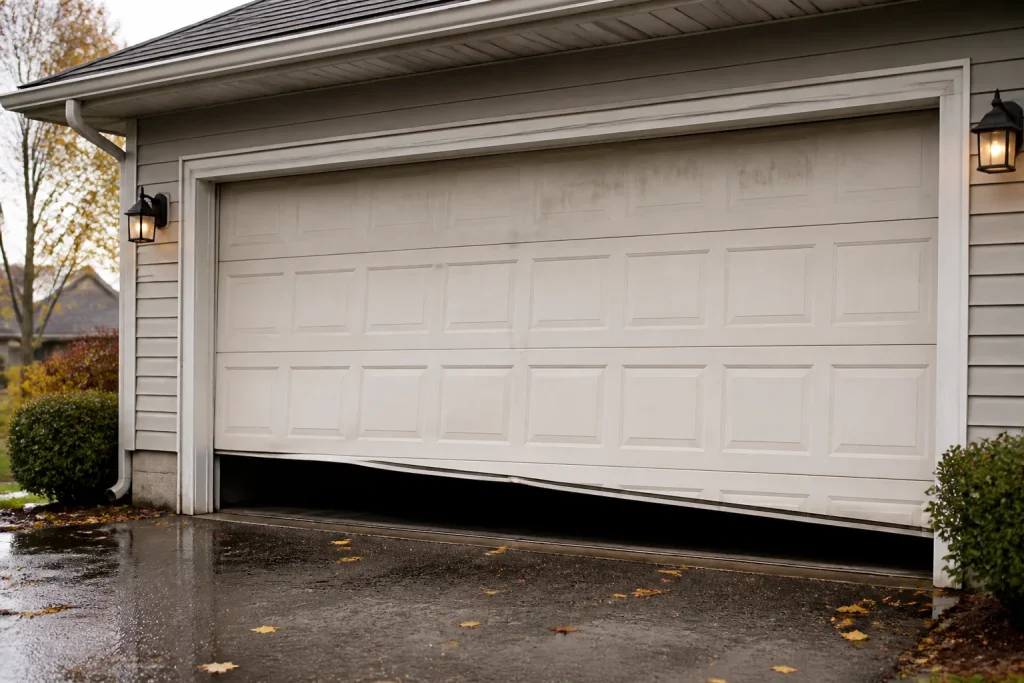
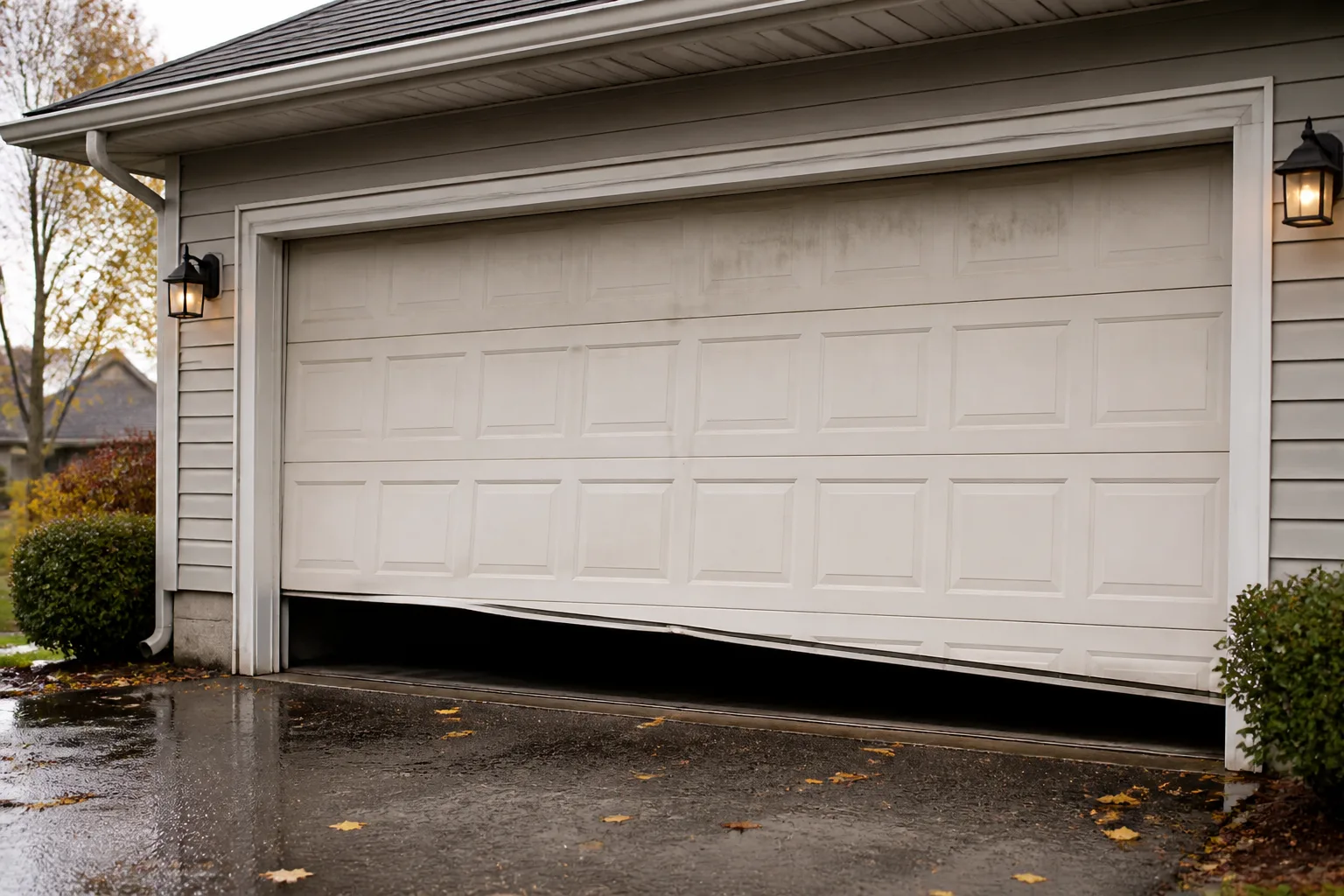
Stop using your garage door immediately if you can see a cable loop hanging loose over the drum at the top corners of the door. That slack means the cable is no longer seated under tension, and a cable that fails under load can whip and cause serious injury. The same goes for a visible gap in a torsion spring or a door that’s hanging visibly crooked. Park outside and call a professional.
Cables and springs are the two parts of a garage door that store energy. A torsion spring can carry hundreds of pounds of load, and the cable works right alongside it. Neither is a part to touch with the door under tension, and we’d say that even to someone who’s handy. garage door spring repair is a safety-critical job that deserves a trained set of hands, and it’s a named service for us rather than a vague line item.
What to check without touching anything:
- Stand back and look at both top corners of the door. Are the cables running straight and tight against the drum?
- Look along the torsion spring above the door for a visible gap or a spring that looks unwound.
- Check whether the bottom panel sits level with the floor. A crooked door puts uneven load on one side.
If any of those look wrong, don’t test the door by opening and closing it. Call (844) 493-4287, and we’ll get a specialist out to look. We answer 24/7, with fast dispatch from 7am to 7pm, Sunday through Friday.
Why is your door taking longer to open? (And why it’s usually not the opener)
A slow, labored opener is usually a spring balance problem, not a motor problem. When spring tension drops, the door gets heavier than the opener was matched to lift. The motor works harder every cycle and starts to sound tired. Replacing the opener before checking the spring balance means paying for a new motor to struggle against the same imbalance, and it will wear out faster too.
Think of the spring and the opener as a team. The spring carries most of the door’s weight; the opener supplies the push. As tension fades, the opener takes on more of the load. You’ll notice it first as a door that hesitates, then as an opener that strains or a motor you can hear from the kitchen.
This is where brand knowledge earns its keep. If your opener is a Chamberlain or a Genie, we know how its force settings and travel limits behave, and we can tell whether it’s genuinely underpowered or just fighting a door that needs balancing. “Garage doors are all we do,” so when a technician looks at your system, the answer is usually clear within a few minutes.
Before you replace an opener, have the springs checked. It’s the difference between fixing the real problem and buying a new motor that inherits it. When the opener itself is the culprit, that’s a separate job covered under garage door opener repair.
Why does your door reverse before it closes?
A door that reverses before it closes is usually a safety sensor problem in warm months and a track alignment problem in cold months. Understanding which one you’re facing keeps you from adjusting the wrong part. Both issues matter because a door that won’t close all the way leaves the garage open, and a door that reverses on its own may be hitting resistance it shouldn’t.
Here’s how we tell the difference around Crystal Lake:
- Warm-weather reversal. Sun glare can confuse the safety sensors, especially if one is facing the afternoon sun. Dust and cobwebs on the lenses cause the same effect. If the reversal happens mostly on bright days, suspect the sensors.
- Cold-weather reversal. The metal track contracts and shifts in freezing temperatures. A door that rubs on a slightly out-of-line track gets enough resistance to trip the opener’s safety reverse. If it happens more on frigid mornings, suspect the track.
You can check the sensors yourself. Make sure both lenses are clean and the brackets haven’t been bumped. Most sensor pairs have a small indicator light that stays on when they’re aligned and aligned to each other. If the lights are on and the door still reverses in cold weather, the issue is probably in the track or the door’s balance, which is a job for a specialist. A door that reverses intermittently can also mean loose cables on one side, so treat a stubborn reversal as a prompt to get it looked at rather than a minor quirk.
What does a frayed cable look like, and why does it matter?
A frayed cable looks like a thin braid with loose strands sticking out sideways, usually near the drum or the bottom bracket. Most homeowners walk past it every day without recognizing it as a snap warning. Once strands start breaking, the cable is holding less load than it was designed for, and the wear accelerates. The fix is a cable replacement, not a tightening.
Here’s what to look for on a walk-around:
- Strands fraying or curling outward at either end of the cable.
- A cable that looks slack on one side compared to the other.
- Rust or a kink where the cable wraps the drum.
- A door that hangs lower on one side than the other.
This is the check we’d ask any Crystal Lake homeowner to do monthly. It takes less than a minute. What we don’t want you to do is tighten or adjust a cable yourself. Cables are under serious tension, and a loose one can snap back hard. If you see fraying, stop running the door and call a specialist. If your door has a Clopay or Amarr model, we can match the right cable and hardware to the frame and drums, so you’re not relying on a generic part.
When should you call a pro?
Call a pro the moment the problem touches springs, cables, or a door that behaves unpredictably. Friction noise, sensor alignment, and track debris are worth a look yourself. Anything that stores tension, holds the door’s weight, or could slam a door on a person should go to a specialist. Our technicians have up to 13 years of experience, and springs and cables are where that training matters most.
If you’re in Crystal Lake and you’d rather have a second set of eyes, garage door repair is what we do every day, and we’ll tell you plainly whether it’s a small fix or a bigger job.
The Bottom Line
The signs that a garage door needs service are usually there before a failure, and they point to a specific part. A new noise, a slow opening cycle, a frayed cable, or a door that reverses are all the door telling you which component needs attention. The earlier you catch it, the more likely a Spring repair or balance adjustment is the only thing you need, rather than a new opener or a bigger installation job.
From broken spring to brand-new door, the goal is the same: your door, diagnosed right the first time, whether it’s a LiftMaster opener, a Wayne Dalton door, or anything in between. If you’re not sure, don’t force it. If you’re in Crystal Lake and need help, Crystal Lake Garage Door Repair Pros offers free estimates. Call (844) 493-4287. We answer 24/7. Fast dispatch from 7am to 7pm, Sunday through Friday.
Frequently Asked Questions
A broken torsion spring usually makes a loud bang, and the door becomes very heavy or won’t open at all. On a torsion system, you’ll often see a visible gap in the spring above the door. Extension springs fail differently, sometimes dangling toward the floor. Either way, stop using the door and call a professional. Spring work is dangerous, and it’s not a repair to attempt yourself. Call (844) 493-4287 for a free estimate.
No. A squeak is usually harmless on its own, but it’s a sign that hinges or rollers have lost lubrication and are wearing faster than they should. Left alone, friction can bend a track or seize a roller and put more load on the opener. It’s one of the cheapest problems to catch early and one of the more expensive ones to ignore.
A door that opens a few inches and stops often has a spring or balance problem, or an opener hitting its travel limit because the door is too heavy. On some openers, like certain Genie or Chamberlain models, the force setting can also cause a short stop. Leaving it to guesswork risks damage to the opener. A technician can tell which part is the cause in short order.
Not always, but it’s one worth checking soon. A crooked door can mean a cable has slipped, a spring has lost tension on one side, or a track is out of alignment. Because cable and spring problems can escalate quickly, treat a suddenly crooked door as a reason to stop using it until someone looks at it. Call (844) 493-4287 and we’ll help you sort it out.
Written by the team at Crystal Lake Garage Door Repair Pros.
Need Garage Door Help?
Call Crystal Lake Garage Door Repair Pros - the local pro we connect you with is licensed and insured, here with fast help in Crystal Lake.
(844) 493-4287